


Spanish Jamón Guide: How to Source Ibérico Ham for Hotels, Restaurants & Catering
Are you still choosing jamón based on price per kilo alone? Have you ever had a supplier send you something labelled “Ibérico” that tasted nothing like what you expected — or found yourself unable to explain to your chef why one leg costs three times more than another?
These are the questions that separate businesses who buy jamón from those who truly understand it. Spain produces the finest cured ham in the world. But it also produces a lot of confusion around it. This guide cuts through that confusion, walks you through every grade we carry, and gives you the knowledge to make sourcing decisions you can defend in any direction.
Two Products, One Name — Don’t Confuse Them
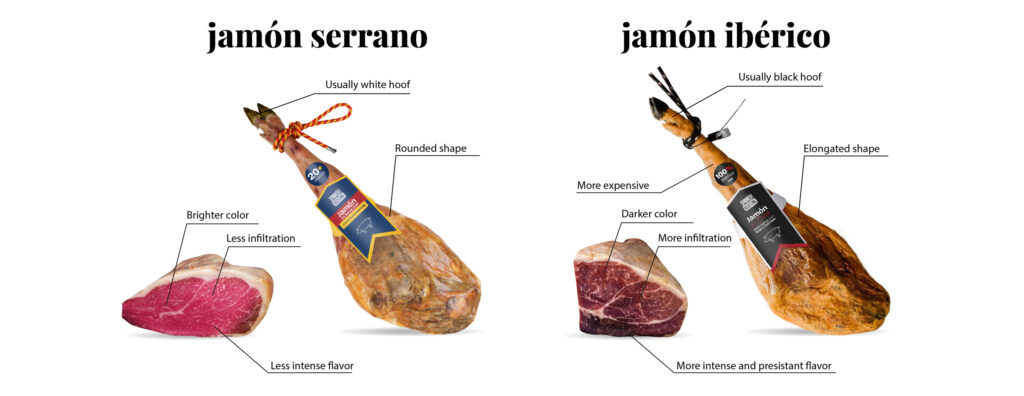
When buyers say “Spanish ham,” they could mean two entirely different things.
- Jamón Ibérico comes from the Iberian pig — a native Spanish breed with a unique genetic capacity to infiltrate fat deep into the muscle fibre. This is what creates the marbling. No other breed does this the same way, and no farming or feeding system can replicate it. When people talk about Spanish ham being extraordinary, they are talking about Ibérico.
- Jamón Serrano — including Duroc-breed Teruel range — comes from white breed pigs cured in the mountain tradition. Commercially excellent, menu-versatile, and honest at its price point. But a fundamentally different product. Your specification documents and menu descriptions should always treat it as such.
The moment you blur this distinction, you either overpay for what you get or underdeliver on what you promised your guests.
The Four Ibérico Grades: What the Label Colour Actually Tells You
Since 2014, Spanish law requires every jamón ibérico to carry a colour-coded label. It is legally binding and the most useful piece of information on the leg.
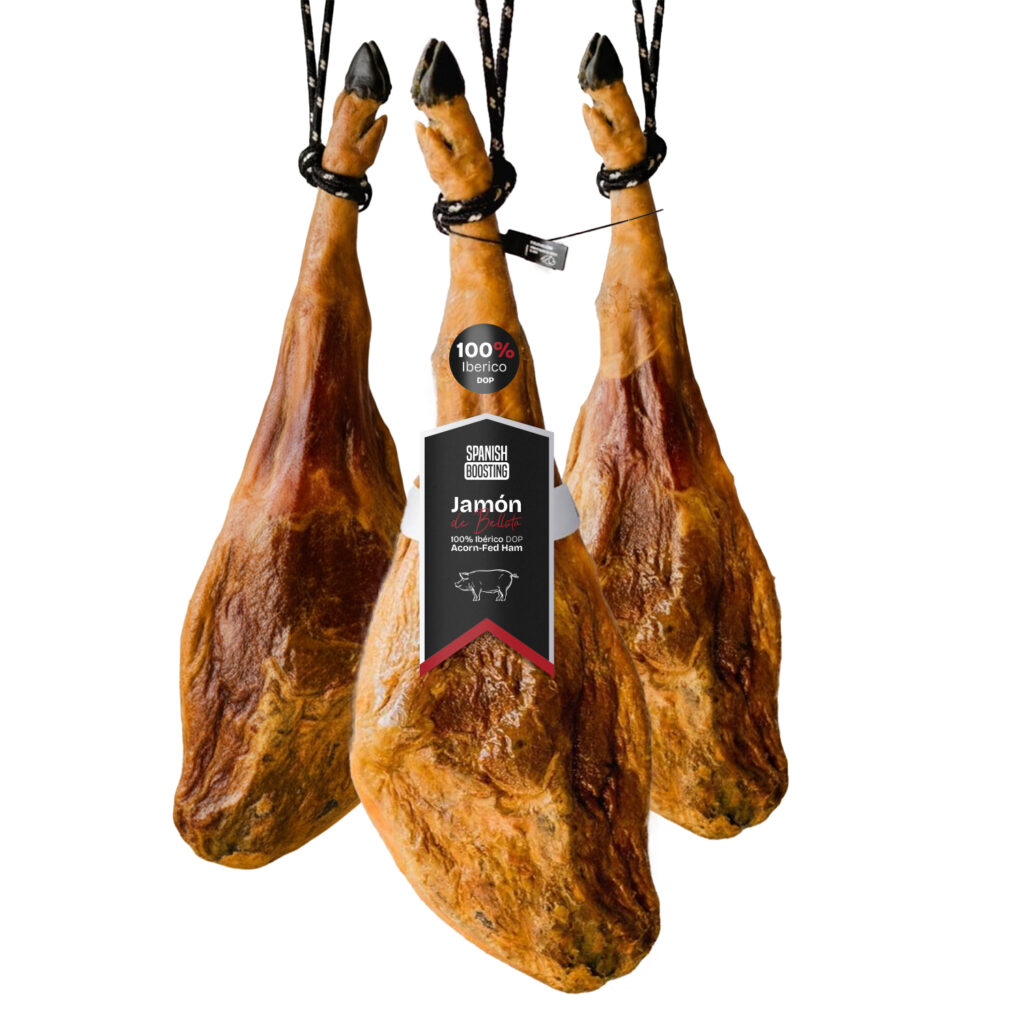
Black Label — Jamón de Bellota 100% Ibérico D.O.P.
Pure-bred Iberian pig. Free-range in the dehesa — Spain’s ancient cork and holm oak forest. Fed exclusively on acorns during the montanera season (October through February), walking kilometres each day to find them, gaining up to a kilogram per day in the process.
The result is a fat unlike anything else in European food culture. High in oleic acid — the same monounsaturated fatty acid found in olive oil — it stays semi-liquid at room temperature, melts on the palate without greasiness, and carries a nutty complexity that no curing technique can manufacture artificially. Our black-label legs carry full D.O.P. certification with a minimum 36-month cure. This is the product that justifies a premium menu position, a tableside carving station, or a high-end gifting programme.
Red Label — Jamón de Bellota Ibérico 50% Raza Ibérica
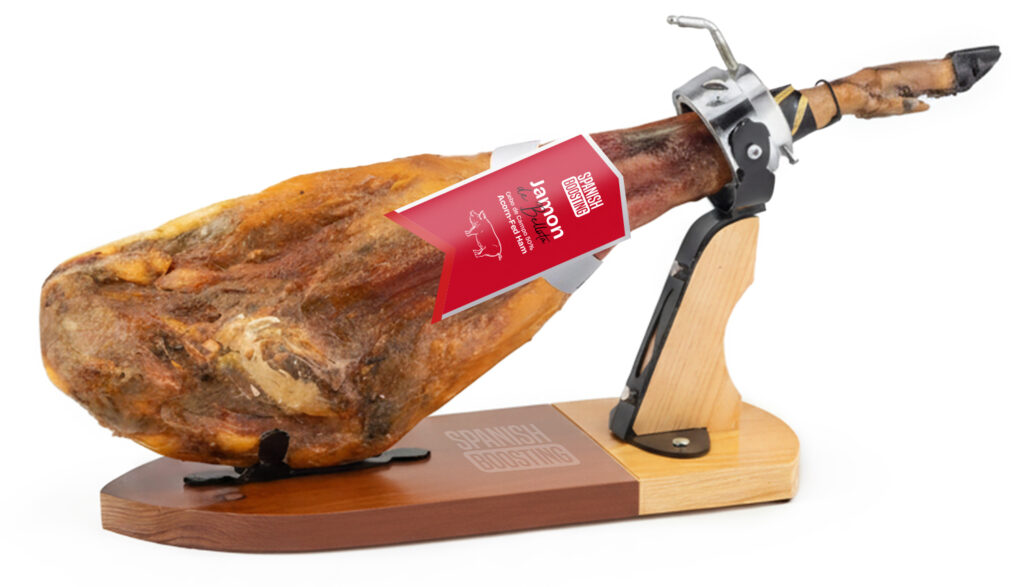
At least 50% Iberian genetics, free-range, acorn-fed during montanera. The bellota fat character is present, the marbling is visible, and the flavour delivers the complexity your guests associate with premium Spanish ham — at a more accessible price than the 100% pure-bred leg. The right choice when you want genuine bellota quality without the top-tier commitment.
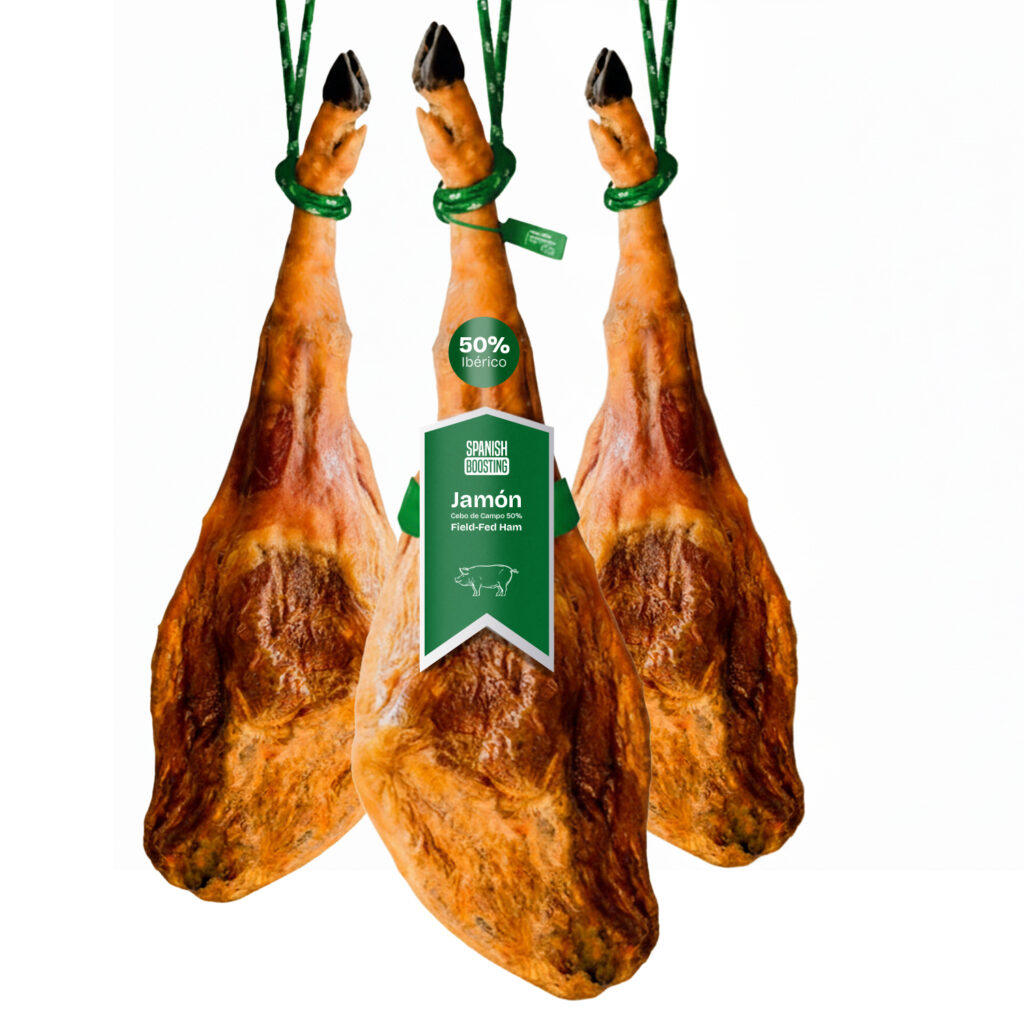
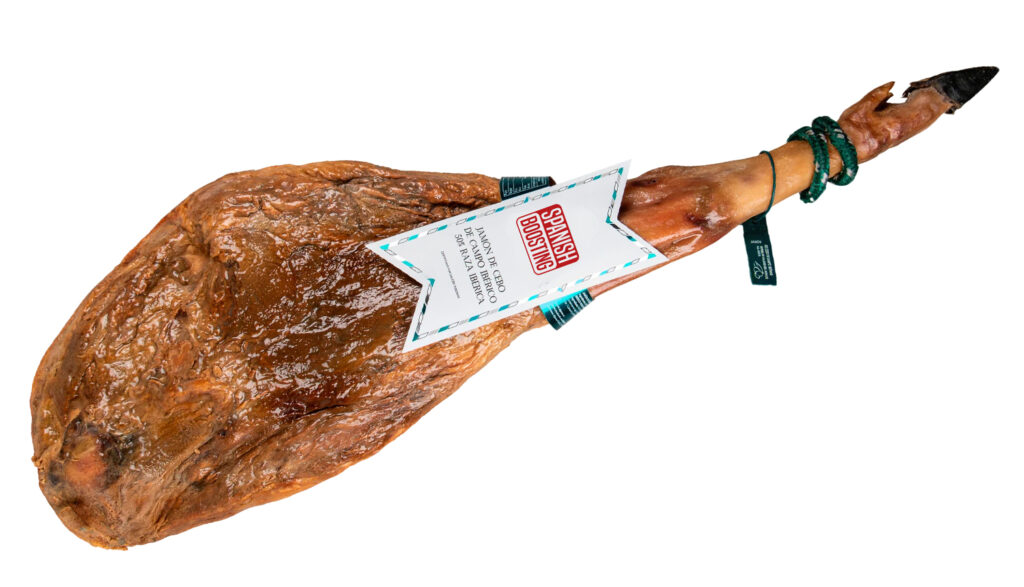
Green Label — Jamón de Cebo de Campo Ibérico 50% Raza Ibérica
Free-range Ibérico crossbred, raised on natural pasture and approved feed — no acorns, but genuine outdoor life that influences both fat character and muscle texture. Marbling is less pronounced than bellota but still far ahead of any white-breed ham.
This is one of the most commercially intelligent choices in our range. Authentic Ibérico credentials, strong across a wide range of menu applications, and a price point that works for hotel breakfast programmes, mid-range restaurant charcuterie, and catering operations where you need Ibérico quality without bellota pricing.
White Label — Jamón de Cebo Ibérico 50% Raza Ibérica
Ibérico crossbred, raised indoors on commercial grain feed. The breed’s fat-infiltrating genetics still produce marbling that no white-breed ham can match — but the fat profile is firmer and the flavour more straightforward than campo or bellota. The right entry point for high-volume Spanish food programmes: staff dining, large catering contracts, sandwich lines where Ibérico traceability matters but plated presentation is not the priority.
The Teruel Range: When Serrano Is the Right Answer
Not every application calls for Ibérico. A well-chosen Serrano outperforms a poorly matched Ibérico in plenty of kitchen contexts — and it will never embarrass your operation if it is specified honestly and used correctly.
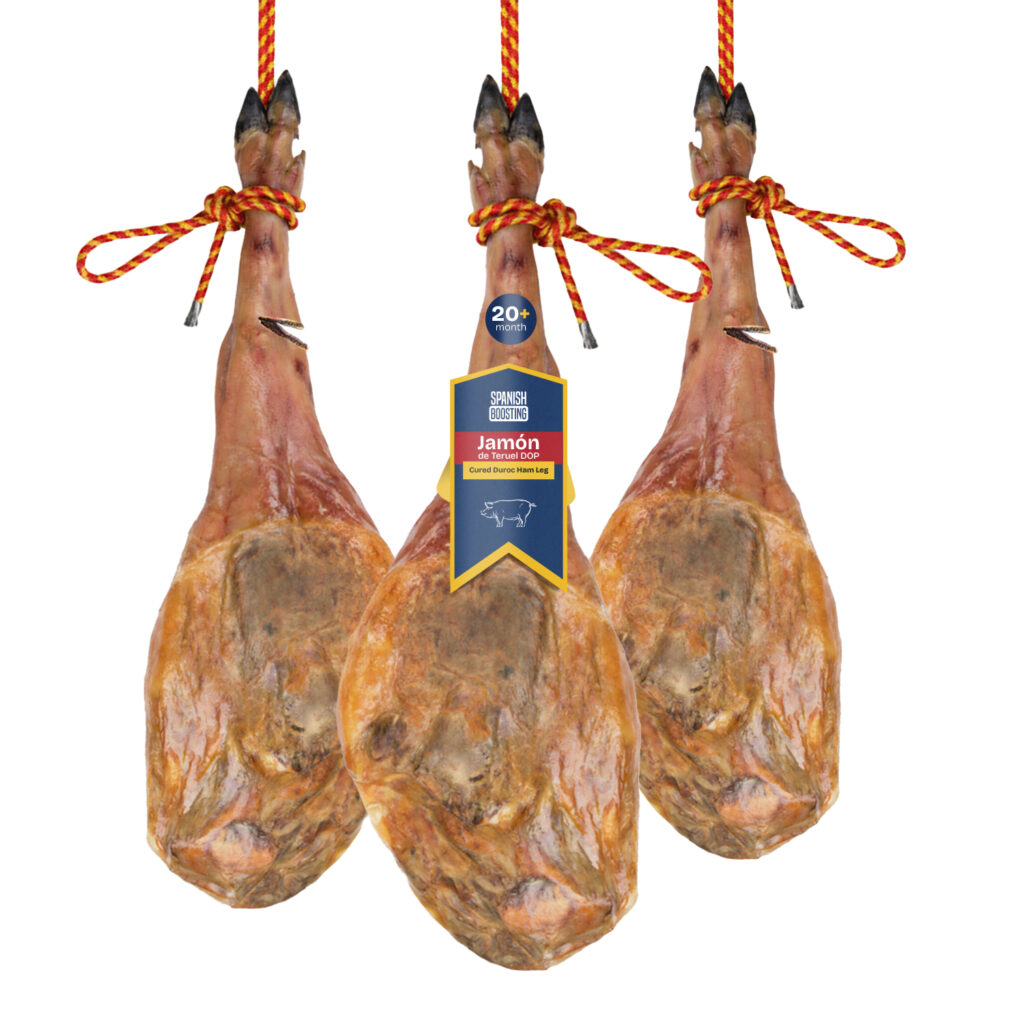
Our Teruel range carries D.O.P. status — one of the most respected Serrano appellations in Spain, produced from Duroc-cross pigs in the high-altitude province of Teruel with a minimum 14-month cure and strict controls on breed, feed, and production.
The Duroc breed gives this product noticeably better fat infiltration than standard Serrano — rosy-red colour, firm yet tender texture, clean slice on a commercial machine. Available bone-in with the traditional V-cut, or boneless vacuum-packed for zero-prep kitchen operations. Also available in block and portion formats for high-volume slicing programmes.
Whole Leg or Boneless? The Format Decision That Affects Your Entire Operation
Whole bone-in legs are right when presentation matters — tableside carving, buffet stations, charcuterie trolleys. They also give you maximum flexibility over how each zone of the leg is used: the maza (the main cushion) for sliced service, the jarrete and punta for cooking, the bone for stock. Yield management on a whole leg rewards a well-trained kitchen team.
Boneless vacuum-packed is right when consistency and labour efficiency are the priority. No carving skill required, no yield calculation, no wastage from uneven cutting. Ready to slice, dice, or portion straight from the package. Every product in our range is available in boneless format.
Many operations run both: a whole leg for the restaurant or bar, boneless product for banqueting and kitchen prep. We can supply both formats from the same product category in the same order.
What the Pig Eats — And Why It Shows Up on the Plate
During montanera, a free-range Ibérico pig consumes between 6 and 10 kilograms of acorns per day. Acorns from holm and cork oak are extraordinarily rich in oleic acid. As the pig accumulates this fat, the Ibérico breed’s unique genetics distribute it through the muscle fibre — creating the marbling you see when you cut a bellota leg.
Oleic acid stays semi-liquid at room temperature. This is why properly sliced bellota jamón glistens and dissolves on the tongue without leaving a greasy residue. You are tasting what the pig ate, concentrated and preserved over 36 months. No commercial feed, no indoor system, and no curing shortcut can replicate it. When all four elements are present and certified — breed, terrain, acorns, time — the result is genuinely irreplaceable.
Which Jamón for Which Application
| Grade | Best applications |
| Black label bellota 100% D.O.P. | Fine dining, tableside carving, premium gifting, tasting menus |
| Red label bellota 50% | Restaurant charcuterie, boutique hotel breakfast, upscale tapas |
| Green label cebo de campo 50% | Hotel buffets, mid-range starters, event catering |
| White label cebo 50% | High-volume kitchen, staff dining, sandwich programmes |
| Teruel Duroc — whole or boneless | Daily slicing, tapas bars, banqueting sandwich lines |
Why Source Through Spanish Boosting?
We are not a single-product supplier. We are a Spanish ham supplier exporting the full jamón range — from D.O.P. Teruel Serrano to 100% Ibérico Bellota — alongside olive oil, cheese, conservas, and every other Spanish food category your operation needs.
The practical advantage: instead of managing separate suppliers, separate minimum orders, and separate containers for each product line, you consolidate everything into one order, one container, one invoice. For international HORECA buyers, that consolidation reduces your total landed cost and eliminates the complexity of juggling multiple export relationships.
Every shipment comes with full traceability documentation and the certifications required by your market’s food safety authority.
Get in touch and we’ll send you our personalised catalogue with the full jamón, pricing, and specifications — we’re here to help.
Frequently Asked Questions
What is the difference between jamón ibérico and jamón serrano?
Jamón ibérico comes from the native Iberian pig breed, which has a unique genetic ability to produce intramuscular fat marbling. Jamón serrano comes from white breed pigs such as Duroc, cured in the mountain tradition.
The breed, feeding, curing time, and flavour profile are all different — and so is the price. They should never be substituted for one another in a menu description or procurement specification.
What does “bellota” mean on a Spanish ham label?
Bellota means acorn. A jamón de bellota comes from a free-range Ibérico pig that was fed on acorns during the montanera fattening season (October to February).
The acorn diet produces a fat high in oleic acid — the same fatty acid found in olive oil — which gives bellota ham its characteristic marbling, melt-on-the-tongue texture, and complex flavour. Only black and red label jamón ibérico can legally carry the bellota designation.
What is D.O.P. Teruel and why does it matter for purchasing managers?
D.O.P. Jamón de Teruel is a Protected Designation of Origin for Serrano-style ham produced in the high-altitude province of Teruel, Aragon. It guarantees breed standards (minimum 50% Duroc genetics), minimum curing time (14 months), and full production traceability.
For a purchasing manager, a D.O.P. certification is an auditable quality guarantee — not just a marketing claim.
How long is Spanish jamón cured?
It depends on the grade:
- Jamón serrano Gran Reserva: minimum 15 months.
- D.O.P. Teruel: minimum 14 months.
- Jamón ibérico de cebo: minimum 24 months.
- Jamón ibérico de bellota 50%: 24 to 36 months.
- Jamón de bellota 100% ibérico D.O.P.: minimum 36 months, with the finest pieces spending 48 months or more in the bodega.
Curing time is a flavour specification, not a storage detail — longer curing means deeper enzymatic activity, more amino acid development, and more complex umami character.
Can I order Spanish ham boneless for export?
Yes. Every product in the Spanish Boosting jamón range is available boneless and vacuum-packed for export. Boneless format simplifies cold chain logistics, eliminates carving labour, and allows precise portion control — making it the preferred format for most HORECA wholesale and export programmes.
What is the best Spanish ham for a hotel breakfast buffet?
For a hotel breakfast buffet, the green label Jamón de Cebo de Campo Ibérico 50% offers the best balance of authentic Ibérico quality and commercial cost per cover.
For operations that prefer a more budget-efficient option without compromising on honest quality, the D.O.P. Teruel Duroc is an excellent choice — particularly in pre-sliced or boneless block format.
Related Posts

Spanish Boosting at Biofach & Gulfood 2025: Meet Us at the Leading Food Exhibitions!
February 2025 is an exciting month for the food industry, with Biofach 2025 in Nuremberg, Germany and the 30th edition of Gulfood 2025 in Dubai, UAE taking place. Spanish Boosting is proud to announce our participation in both of these prestigious trade fairs, where we will showcase our extensive range of Spanish retail food products […]